






« Testing cell culturing with shaped biofoam | Main | Responses from couples »
March 01, 2005
Rapid prototyping
Just an quick update, we will not be using rapid protptyping to "print" the bioactive scaffold, though this technology is being developed at Manchester university (It's a little unlear if this technology is printing a scaffold seeded with cells, or just the scaffold).
We will be using 3-d modeling to design the parts of the rings which we intend to cast in metal. We print this form using the rapid prototyper, then use it to make a cast. The printed form melts at 148 C, leaving a cavity in the rubber cast for the metal.
We will prepare then scan the final bone tissue sample so we have a 3-d model of this, then we can use 3-d software to combine the metals with the bone. Then when the metals are cast, the materials will fit together well.
The rapid prototyping machine is the Prefactory. A 3-d model is transformed into a series of black and white images, which are slices through the model. The machine can print at steps of 15 microns and at this granularity the steps are not visible to the eye. Thats a large stack of slices, even for a small object. 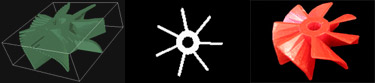
The sliced model, one of the slices and a finished object
Each slice is used as a mask, white areas allow light from a high end projector to be focussed onto a plate of resin, which hardens in the exposed areas. The platform is then raised, and the next slide is used to expose the next layer. Each layer take about 20 seconds, or about 3 hours for something the size of a ring. We aim to get some timelapse photopraphy of this, in the meantime this movie shows the slides which make up a job lot of 18 identical rings, originallly 1024 bitmaps at a size of 1280 pixels by 1024 pixels.
Looking again at the Envisiontech site, they have a product called the Bioplotter which looks very interesting...
Dan Collin's has writen some interesting essays on rapid prototyping. Here are some more details about the format of the files which get passed to the prototying machines, this describes two different processes to the one we are using.This is a translation of fine essay by Christian Lavigne on this technology.
Posted by tobie at March 1, 2005 11:12 AM